
Ste. Genevieve County Arrest Records and Charges
Arrest records and court charge records are related, but they are not the same file. The arrest record comes from the custody event: law enforcement takes a person into custody, booking occurs, and the jail may hold the person while bond, release, transfer, or court transport is arranged. In Ste. Genevieve County, jail and custody information routes through the Sheriff's Office Detention Center and VINELink channels.
The court charge record starts after the Prosecuting Attorney reviews law-enforcement reports and decides whether to file charges. Wayne Williams is the Ste. Genevieve County Prosecuting Attorney. His office explains that a case number is usually available within a few days after charges issue. The full court case, including pleas, motions, dispositions, and sentencing, belongs with Ste. Genevieve County criminal court records.
Court Charges After Arrest
The Prosecuting Attorney is the key office between an arrest and a court charge. Law enforcement may investigate a reported crime and submit reports to the prosecutor. The prosecutor then decides whether the facts support criminal charges. Some disputes remain civil and do not become criminal charges. When charges are filed, they become part of the court case and can be searched through Case.net if public.
The official Prosecuting Attorney page is the local source for this charging path, traffic amendments, victim resources, restitution instructions, and public defender referrals. The office is at 55 South Third Street, Room 7, Ste. Genevieve, MO 63670, with phone 573-883-2265 option 9 and preferred email office@stegenpa.com.
Find Ste. Genevieve County Arrest Records
Charge lookup begins in Missouri Case.net, because the court record shows the filed charge and status. Search by defendant name or case number, narrow to Ste. Genevieve County - 24th Judicial Circuit, and open the charge tab and docket entries. For custody status or jail-related booking context, use the county detention route and VINELink, not the court docket.
- Use Case.net for court charges after arrest and select the Ste. Genevieve County court filter.
- Search by defendant name, case number, or ticket number when traffic charges are involved.
- Open the case and review each charge description, statute or ordinance, severity, and status.
- Check docket entries for bond, warrants, hearings, amended charges, plea events, and disposition.
- Contact the Circuit Clerk for court copies or the Detention Center for custody and letter-of-incarceration questions.
Current custody and jail facts are separate from charge status. The Ste. Genevieve County Detention Center is at 5 Basler Drive and can be reached at 573-883-5820. VINELink is linked from the county detention page for custody information and notification.
Ste. Genevieve County Charge Documents
A charging document is the paper or electronic filing that starts the formal court accusation. Missouri criminal cases may use a complaint, information, indictment, or other charging entry depending on the case path. The public case record may not show the full image of the document, but it can show the charge text, statute, classification, and filing date.
| Complaint | Information | Indictment | |
|---|---|---|---|
| Common Source | Officer or prosecutor-supported accusation | Prosecutor filing | Grand jury accusation |
| Typical Use | Initial criminal filing or probable-cause path | Many prosecuted criminal cases | Serious cases where grand jury route is used |
| Record Role | Starts or supports the court charge | States the formal charge in court | States charges returned by grand jury |
| Where to Check | Case.net docket and clerk file | Case.net charges and clerk file | Case.net charges and clerk file when public |
Ste. Genevieve County Charge Fields
The charge area of a court record focuses on the allegation. It may show charge descriptions, statute citations or ordinance citations, severity, bond events, plea, disposition, sentence, and amended-charge history. One arrest can produce more than one charge. One case can also include charges that end differently, such as one dismissed count and one conviction.
| Charge Field | What It Means |
|---|---|
| Charge Description | The text label for the alleged offense filed in court. |
| Statute or Ordinance | The legal citation tied to the charge, when shown publicly. |
| Classification | Whether the charge is listed as felony, misdemeanor, infraction, or ordinance matter. |
| Bond Event | Release terms, cash bond, surety bond, no-bond status, or changes recorded in the case. |
| Plea | The defendant's answer to the charge, such as guilty or not guilty, when entered. |
| Disposition | The result for that charge, such as dismissed, guilty, acquitted, or otherwise resolved. |
Charge Status After Arrest
Charge status can change over time. A pending charge is unresolved. An amended charge has been changed by the prosecution or court process. A reduced charge is a lower or different allegation than the first filing. A dismissed charge ends without conviction on that count, though the same case may still include other charges.
| Status | What It Means |
|---|---|
| Pending | The charge is still open and has not reached final disposition. |
| Amended | The original charge text, citation, or level changed during the case. |
| Reduced | The charge was changed to a lower level or different offense. |
| Dismissed | The charge ended without a conviction on that count. |
| Nolle Prosequi | The prosecution declined to proceed on that charge or count. |
| Disposed | The charge reached a final result by plea, verdict, dismissal, or other court action. |
Bond and Custody Records
Bond and custody details can appear in more than one place. The court docket may show bond amount, cash-only bond, cash or surety terms, or a bond event. The jail handles booking, release, property, letters of incarceration, and current custody logistics. The county detention FAQ says some bonds must be posted at the Circuit Clerk's Office during courthouse hours, while other cash or surety bonds may be handled at the Detention Center.
The Missouri State Highway Patrol Ste. Genevieve arrest news release is a recent law-enforcement source from the manifest set.
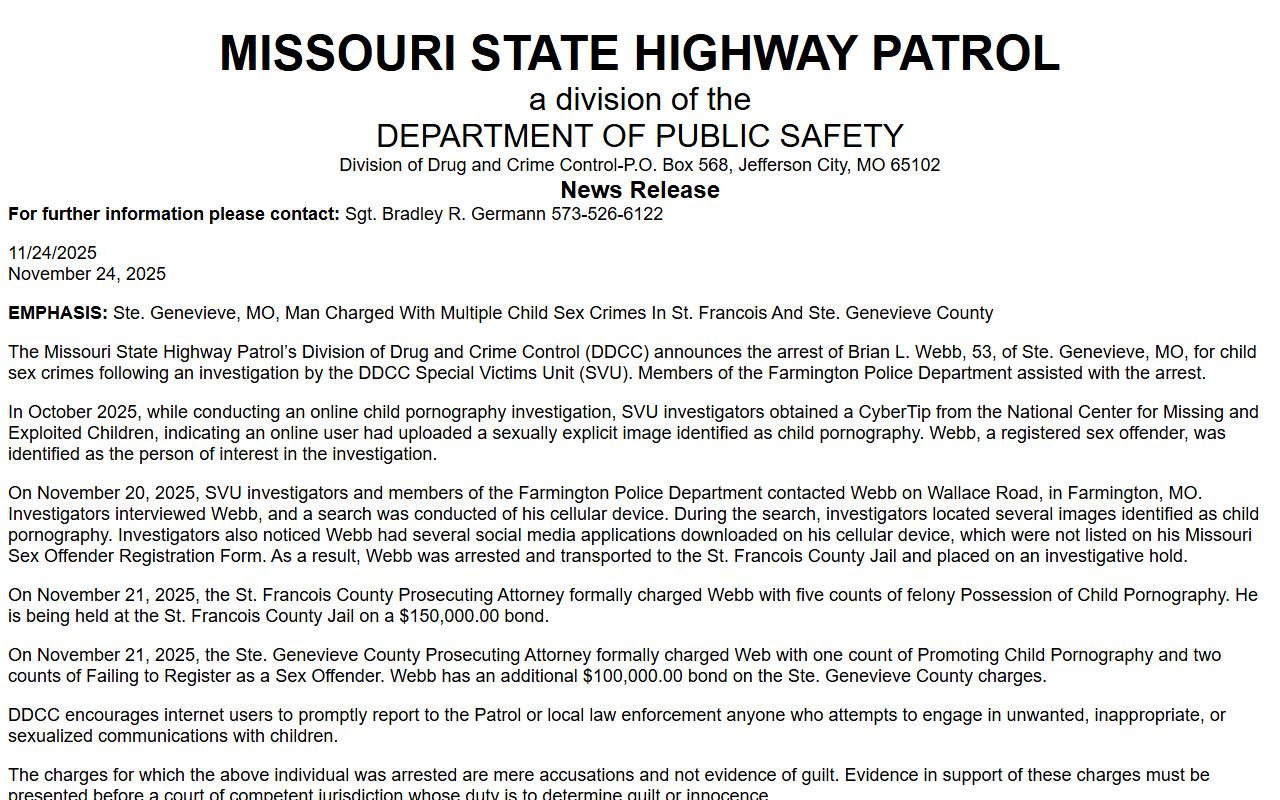
An arrest announcement should not be treated as a conviction. Court status must be checked through the filed case record.
Charges vs Convictions
A charge is not proof of guilt. It is the accusation filed after prosecutor review. A conviction is the court result after a guilty plea, finding, or verdict. In Ste. Genevieve County arrest records and charges, this distinction is critical because an arrest can lead to no charge, a filed charge can be dismissed, and a case can include both dismissed counts and convicted counts.
| Charge | Conviction | |
|---|---|---|
| Stage | Filed accusation after prosecutor review | Final guilty result |
| Record Location | Charge tab and docket entries | Disposition, judgment, and sentence entries |
| Can Change | May be amended, reduced, dropped, or dismissed | Can be challenged or expunged only through legal procedures |
| Reader Caution | Do not treat as final guilt | Read sentence and any later case activity |
Restricted Ste. Genevieve County Charge Records
Juvenile charges, sealed cases, expunged records, and protected personal information may not appear in a public charge search. RSMo 211.319 limits juvenile-file access. RSMo 455.004 makes listed juvenile-court protection-order records confidential except for specified people or court order.
The juvenile statute source below is assigned to this page in the successful manifest. Missouri's juvenile proceeding access statute explains why some arrest-to-charge paths do not produce ordinary public results.
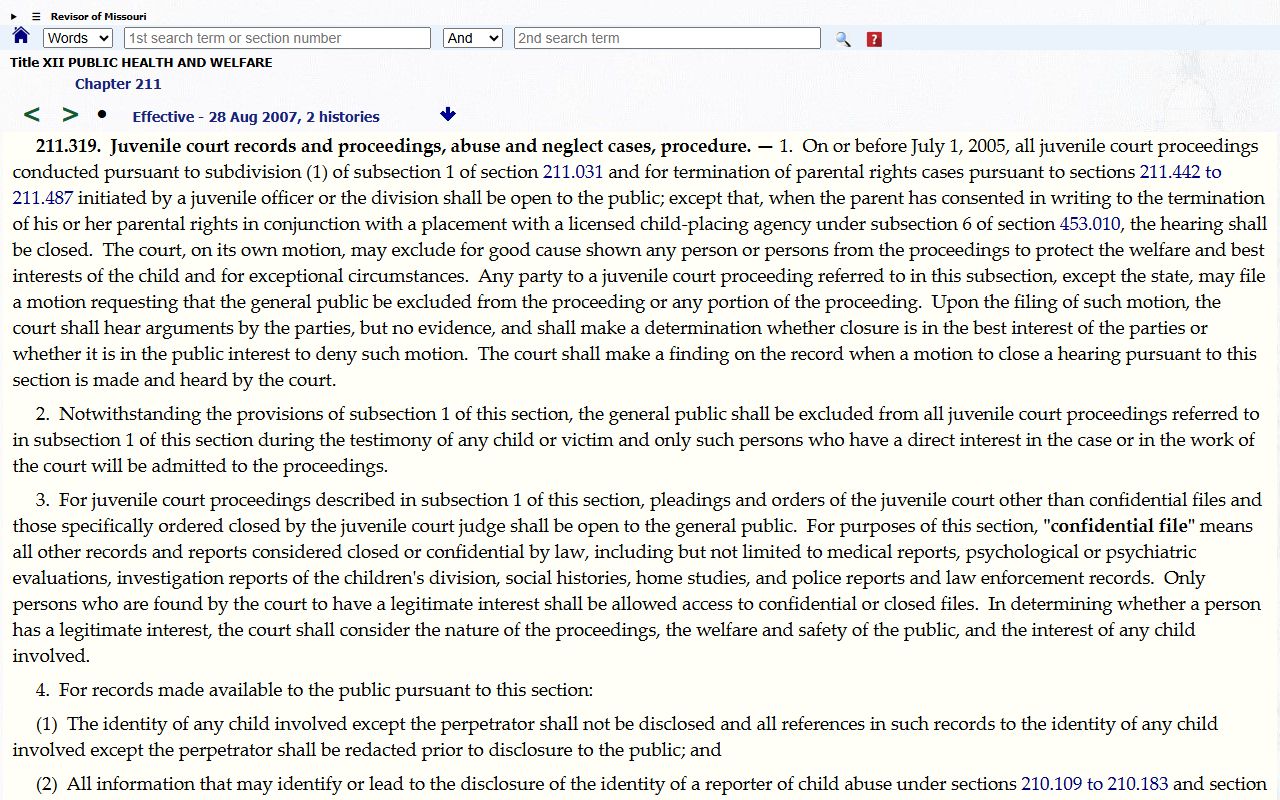
Juvenile access rules protect files even when an event would otherwise look like a criminal or charge record to the public.
Expunged Arrest Records and Charges
Missouri expungement can limit public access to eligible criminal records after a court process. RSMo 610.140 is the core Missouri expungement statute identified in the research. Ste. Genevieve County expungement filings go through the Circuit Court, and the Circuit Clerk can provide filing logistics. Eligibility, waiting periods, and legal strategy are not clerk-advice issues.
| Sealed | Expunged | |
|---|---|---|
| Public Access | Restricted by order, rule, or law | Limited after a granted petition under Missouri law |
| Case Search Effect | May show no public detail or only limited docket data | Should not appear like an ordinary public case result |
| How It Happens | Case type, court order, or confidentiality law | Petition filed in court if statutory criteria are met |
| Local Office | Circuit Clerk for record logistics | Circuit Clerk for filing logistics and copies allowed by law |
The successful manifest also includes the Missouri criminal-record expungement statute as a source image.
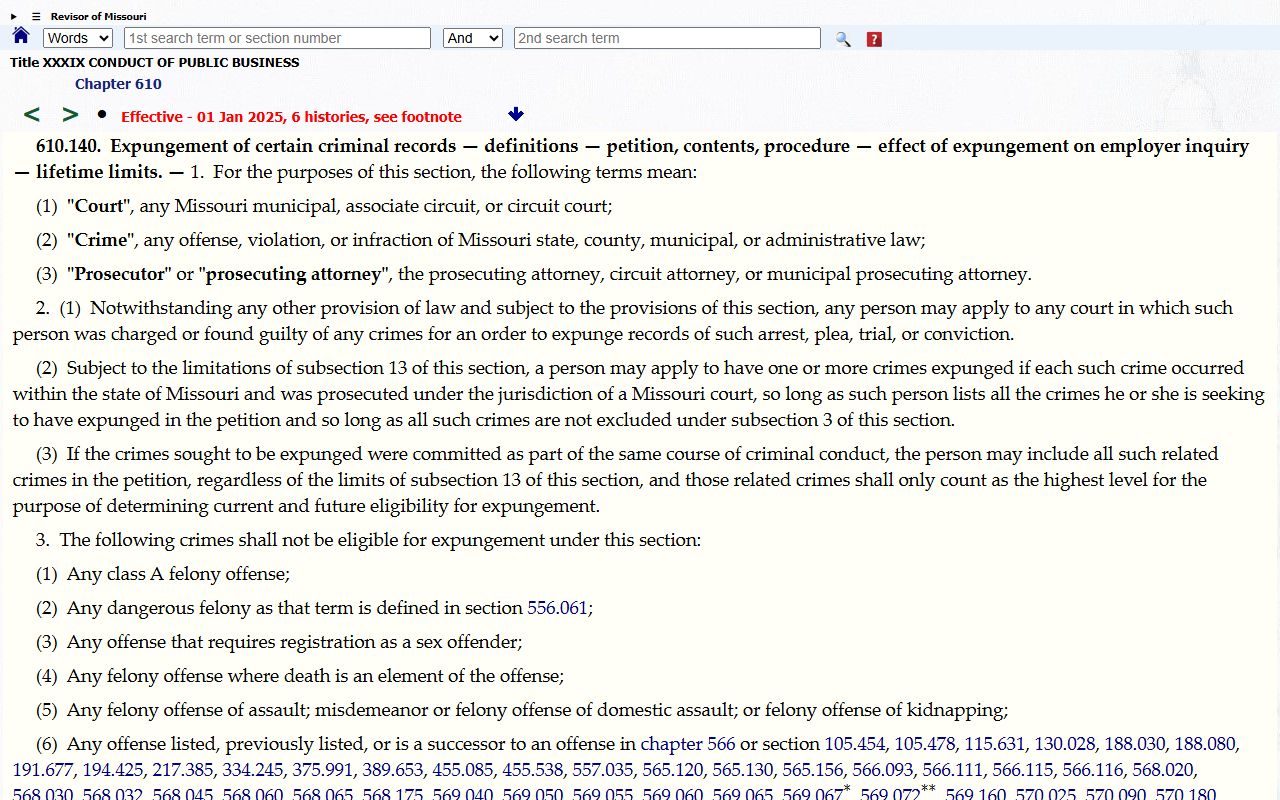
Expungement is a court outcome, not an automatic change just because a charge was dismissed or reduced.
Victim and Defense Routes
The Prosecuting Attorney links victim resources, MOVANS/VINELink, DOC victim services, Crime Victims' Compensation, and RSMo 595.209. A victim who wants charges dropped must provide a notarized written statement explaining the request, but the prosecutor may still proceed. That is why charge status must be checked in the court record rather than assumed from a private request.
Defendants may contact the Missouri State Public Defender Farmington District 24 office or complete a Public Defender Application at the Circuit Clerk's Office. The public defender route belongs to the court case after charges are filed. Arrest custody, bond posting, jail visitation, and letters of incarceration remain separate jail functions.
Important: Arrest records, filed charges, and convictions are different events and should not be merged in a public search.